
The number of cases brought to Singapore’s Financial Industry Disputes Resolution Centre continued to rise over the past year, reaching a record high in its 21-year history. Scam-related claims accounted for nearly half of the cases, with the median claim rising to S$5,000 and more than half of claimants aged over 51.
The Financial Industry Disputes Resolution Centre (FIDReC) released its annual report for the 2025/26 financial year on Thursday (26 November). From July last year to June this year, it received 5,344 claims, up 23% year on year.
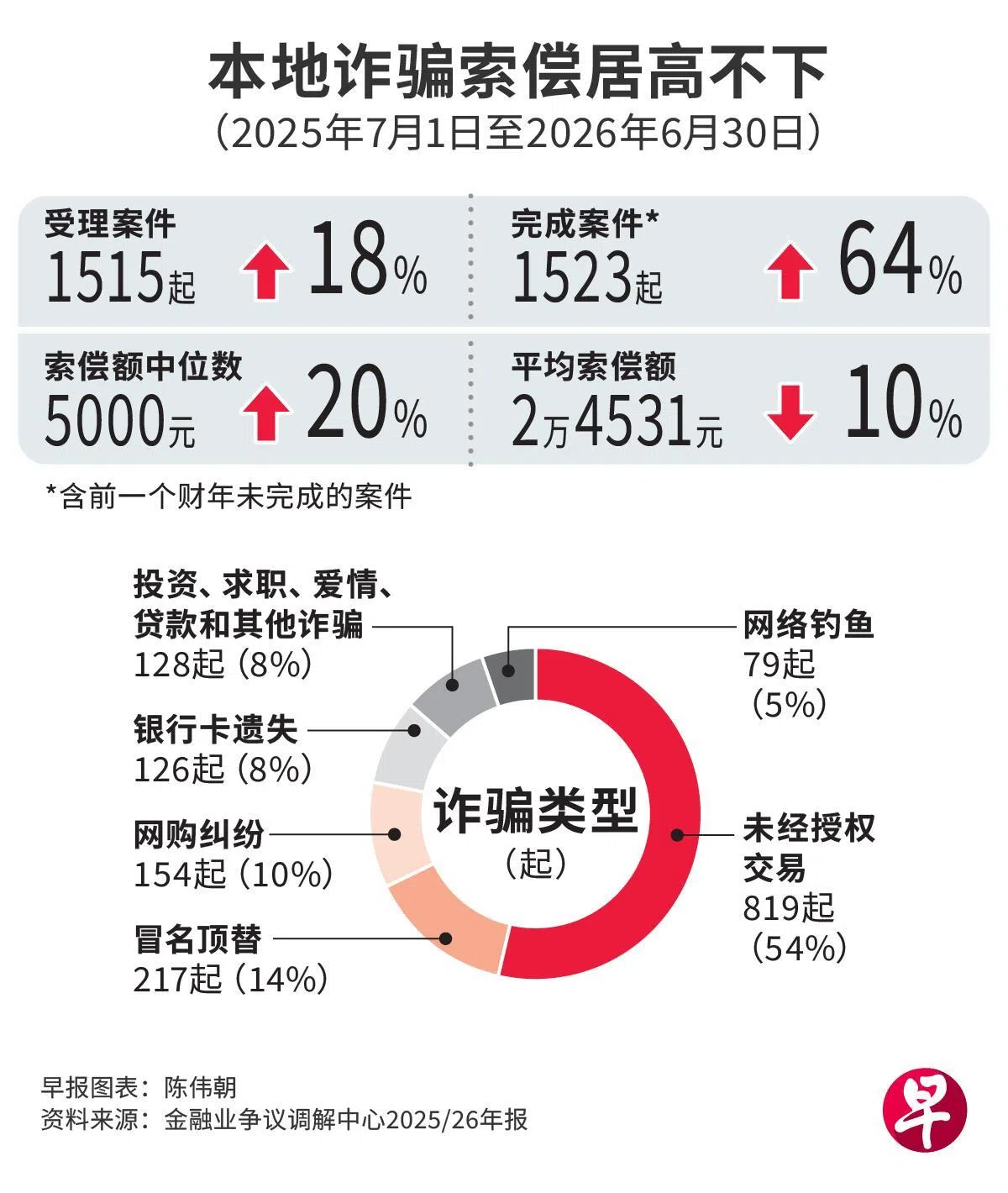
FIDReC formally took on 3,356 cases, of which 1,515 were scam-related claims. This was an 18% increase from 1,285 in the previous financial year and accounted for 45% of all cases taken on.
Of the 1,523 scam-related cases concluded in the last financial year, including those carried over from the previous year, 54% involved compromised credentials, with consumers discovering unauthorised transactions in their bank accounts, on their bank cards or in their e-wallets.
Other categories included impersonation (14%), online shopping disputes (10%), lost bank cards (8%), phishing (5%), and investment, job, love, loan and other scams (8%).
Older consumers hard hit as number of claimants aged 71 and above doubles
By age, those aged 51 and above accounted for 53% of scam-related claimants, up four percentage points year on year. The number aged 71 and above more than doubled from 59 in the previous financial year to 130.
Among the scam-related claims concluded, 958 (63%) ended with financial institutions and consumers reaching an agreement through mediation. In another 417 cases (27%), no agreement was reached, but consumers agreed to close the cases. The remaining 148 proceeded to adjudication, with only 19 (1%) resulting in rulings in favour of consumers. Overall, 88% of scam-related claims were concluded within six months.
According to the annual report, the median claim across all cases was S$5,655, up 16% year on year, while the average rose marginally by 2% to S$47,572. For scam-related claims, the median increased by 20% to S$5,000, while the average fell 10% to S$24,531.
FIDReC chief executive Eunice Chua told Lianhe Zaobao that consumers who cannot recover money lost to scams through the police or their financial institutions sometimes turn to FIDReC for help. “We understand that police efforts to recover funds often face challenges because the funds are transferred across multiple accounts, including to overseas or cryptocurrency wallets beyond the reach of the Singapore police.”
She therefore urged consumers to take more protective measures, such as using the Money Lock feature, lowering bank card transaction limits and reducing the amount that triggers transaction alerts. Besides staying vigilant, consumers should act immediately if they suspect a scam to avoid further losses.
On whether older consumers are more susceptible to scams, Chua said that although they account for a slightly higher proportion of scam-related claims and generally claim larger amounts, the data reflects only claims submitted to FIDReC and is not representative of scam experiences across the population.
Chua said the largest scam-related claim concluded was for S$1,689,201 and involved a cryptocurrency investment scam. It was dismissed at adjudication. The smallest claim, for S$8.70, involved compromised credentials. The consumer sought compensation from a payment service provider for four unauthorised transactions, and the two parties reached an agreement through mediation.
The annual report also detailed a S$1.2 million scam. Priya, 74, who lives alone, received calls from people posing as bank employees and police officers. They claimed she was suspected of money laundering and had to assist with investigations by transferring her savings in instalments into a “MAS safekeeping account”. The scammers also coached Priya to tell the bank falsely that the money was for a property purchase.
Within two weeks, Priya transferred a total of S$1.2 million. She made a police report and asked the bank to recover the money, but the bank said it could not be recovered as she had authorised all the transfers. Following mediation by FIDReC, Priya agreed to close the case after accepting the bank’s goodwill offer to cover 10% of her losses.