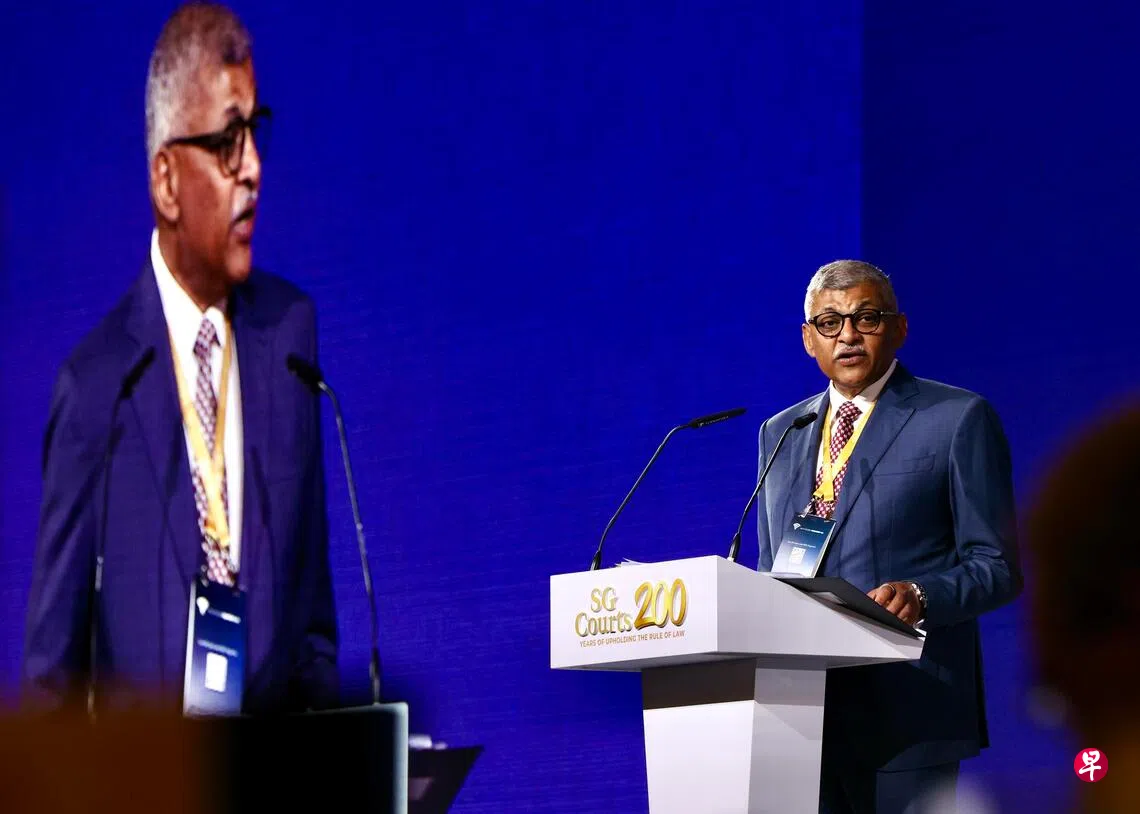
Singapore’s Constitution vests legislative, executive and judicial powers in separate institutions, each of which must respect the others’ constitutional roles and powers. The courts’ role is to interpret and apply the law, ensuring that public power is exercised lawfully. Weighing complex policy considerations and competing societal interests falls within the remit of the executive and legislature.
Chief Justice Sundaresh Menon stressed that judicial restraint in reviewing government decisions does not mean an abdication of responsibility. While the executive and legislature have the latitude to govern effectively and make difficult decisions on behalf of the people, they remain subject to the law, with an independent judiciary ensuring that public power stays within legal limits.
Delivering a keynote address at the Global Rule of Law Conference at Shangri-La Hotel on Wednesday (25 November), the Chief Justice outlined how Singapore’s conception of the rule of law is reflected in its political system, and the relationship between the executive, legislature and judiciary.
He noted that the political branches have a democratic mandate and are equipped to assess complex policy issues through consultation, empirical research and public debate. In judicial review, the courts therefore focus primarily on whether a decision is lawful, rather than substituting their own views for the political branches’ assessment of a policy’s merits.
However, the powers of the political branches are not unlimited. Citing the power of clemency, Chief Justice Menon said that whether to pardon an offender or commute a sentence is a decision for the executive, and the courts will not review the merits of that decision. But the exercise of that power remains subject to legal constraints if it involves an improper purpose or breaches constitutional rights or procedural safeguards.
Earlier this month, the government introduced the Sentencing (Scams) Bill in Parliament. It explicitly provides that offenders who were below 21 when they committed scam offences or facilitated scams should, in principle, be sentenced to imprisonment or corrective training upon conviction. This reaffirms Parliament’s legislative intent to punish scam offences severely and strengthen deterrence.
The proposed amendment responds primarily to a ruling in September this year by a three-judge High Court panel led by Chief Justice Menon. The panel held that rehabilitation should be the primary consideration when sentencing young offenders, and that imprisonment or corrective training should not be the default punishment. The government responded through legislation to a court ruling that did not align with its original policy intent.
Chief Justice Menon did not discuss the Bill in his speech. Instead, he explained how state institutions should interact from the perspective of constitutional law, introducing the concept of “constitutional dialogue”.
He explained that “constitutional dialogue” refers to a decision by one state institution prompting another to respond within its constitutional role. Beyond resolving the immediate dispute in a case, a judicial ruling may also prompt the executive to review existing practices, conduct public consultations or even initiate legislation.
This does not mean that the judiciary has assumed a political function. Rather, the political branches are responding to the legal implications of judicial rulings as they discharge their own constitutional responsibilities.
Dan Tan case and repeal of Section 377A illustrate interaction between institutions
The Chief Justice cited the case of Dan Tan Seet Eng, who was alleged to be the leader and financier of an international football match-fixing syndicate. After the Court of Appeal quashed a detention order issued by the minister under the Criminal Law (Temporary Provisions) Act in 2015, Tan was detained again under a new order that set out the relevant harm in Singapore. The Ministry of Home Affairs also reviewed other detention cases and released three other detainees whose release the court had not ordered.
He also cited the repeal of Section 377A of the Penal Code. When the Court of Appeal heard retired doctor Tan Seng Kee’s case in 2022, it held that, as the Attorney-General had stated that the provision would not be proactively enforced, the appellants faced no real and credible threat of prosecution and therefore lacked standing to mount a constitutional challenge. Although the court did not rule on whether the provision should be retained, it noted that developments in constitutional equality rights could affect future challenges. The Attorney-General subsequently advised the government that there was a significant risk of the provision being found unconstitutional in a future challenge. Following extensive consultation, the government decided to repeal it.
The Chief Justice concluded that Singapore’s communitarian conception of the rule of law is reflected in its constitutional order, which protects individual liberties while taking account of society’s collective interests. The executive and legislature have the latitude to govern, but remain subject to legal limits enforced by an independent judiciary. The institutions can respond to one another while staying within their respective constitutional roles.
The two-day Global Rule of Law Conference is one of the key events marking the Singapore judiciary’s bicentenary. It brings together about 600 judicial leaders, academics and policymakers from 26 jurisdictions worldwide, including 17 current and former foreign chief justices.
On 27 November 1826, the British Crown issued the Second Charter of Justice, introducing English common law to Singapore and other Straits Settlements and laying a crucial foundation for Singapore’s modern legal system.