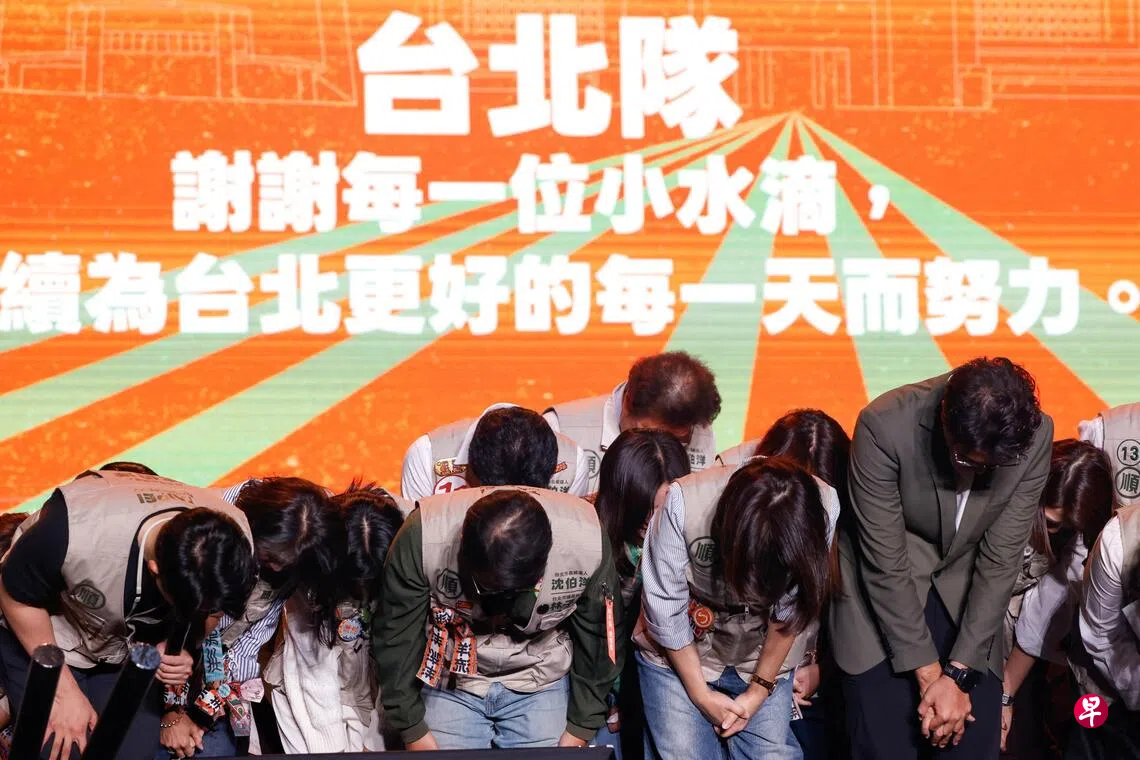
Democratic Progressive Party (DPP) candidate Puma Shen, who inspired a “Puma O’Shen wave” of support ahead of Taiwan’s “nine-in-one” local elections, lost to incumbent Kuomintang (KMT) Mayor Chiang Wan-an on Saturday (28 November). But the campaign has established Shen as a potential successor among the DPP’s new generation. His next challenge is to sustain his public profile and gain administrative experience.
Chiang built his campaign around his incumbency advantage and four-year record in office, focusing on public welfare, urban development and vigorous efforts to develop the artificial intelligence industry. In the closing stages, he stepped up walkabouts and rallies, mobilising supporters with the slogan “A glorious Taipei, moving forward together”. But the “Puma O’Shen wave” put Chiang under intense pressure. TVBS polls showed the gap between their support narrowing from 28 percentage points in May to eight percentage points in October. Before the polling blackout began ten days ahead of the election, the gap briefly fell to just two percentage points, turning the contest into a tight race.
In the final week before the vote, Shen’s campaign faced a series of setbacks. Chiang’s camp repeatedly attacked him over solar power at Feitsui Reservoir, campaigning under the slogan “Don’t make people drink solar-panel water”. Past grants to Taiwan’s Doublethink Lab from the Soros-founded Open Society Foundations also came under renewed scrutiny. Meanwhile, anonymous posts circulated on Taiwanese social media casting aspersions on Shen’s sexual orientation and personal conduct. Shen’s election-eve rally, originally scheduled for Ren’ai Road, was also cancelled because setting up the stage would require road closures and disrupt traffic.
Although Shen lost the mayoral race, the mobilisation behind the “Puma O’Shen wave” spilled over into city council elections. The results showed that, despite his narrow defeat, Shen, the movement’s central figure, helped some DPP candidates win. The party increased its seats on the Taipei City Council from 21 to 23.
As the “Puma O’Shen wave” swept across Taiwan, the DPP also won control of Taichung, ending the KMT’s long hold on the city. The DPP’s Taichung mayoral candidate Ho Hsin-chun joined Shen on campaign motorcades, while the party’s city council candidates also used “Puma O’Shen wave” imagery to rally support, harnessing the movement’s ability to mobilise voters across constituencies. This offered a concrete example of how the DPP linked local candidates and broadened its campaign mobilisation.
Incumbent KMT Taichung Mayor Lu Shiow-yen chaired Chiang’s campaign headquarters in this election. With Taichung lost, her performance in supporting the party’s candidates, as well as the KMT’s plans for the 2028 presidential election, face scrutiny.
Before the election, Taiwan President and DPP Chairman Lai Ching-te singled out Shen and Su Chiao-hui, who ran for mayor of New Taipei City, among others, stressing that “a new generation is taking on a new era”. Former president Tsai Ing-wen, in a livestream with Shen before the election, also encouraged the younger generation: “The responsibility will be yours in future.”
Wang Chih-sheng, secretary-general of the Chinese Asia-Pacific Elite Exchange Association, told Lianhe Zaobao: “The DPP’s new generation of successors is actually already very clear.” He said the younger generation had moved to the front line, from mayoral candidates to local councillors. Whether Shen secures a new role after the election will affect his position among the party’s potential successors.
Before the election, Shen said he would establish a municipal policy think tank, the “Taipei Institute”, even if he lost, to continue discussing city affairs, build local ties and keep open the possibility of another mayoral bid in 2030. Wang said the institute could maintain Shen’s connection with Taipei, predicting: “As things stand, he [Shen] is indeed the DPP’s first choice to contest Taipei again in four years.” However, Shen still needs experience in a central government ministry or agency to address his lack of experience in moving from scrutinising the government to leading an administration.
Chu Chao-hsiang, an adjunct professor at Chinese Culture University’s Graduate Institute of National Development and a former director of Taipei City Government’s civil service training office, also said in an interview that Shen had the qualities to become a next-generation leader but lacked experience in government. “What he lacks now is well-rounded political experience.” Shen also needs to strengthen his team of advisers and familiarise himself with administrative operations to turn his campaign vision into workable policies.
Chu said the “Puma O’Shen wave”, created spontaneously by supporters and then embraced by the campaign team, demonstrated a new model of mobilisation in the social media age. But marketing does not necessarily change the composition of the electorate.
He said: “Marketing methods do have an effect, but the electorate’s political makeup and preferences have not changed as much as people imagine.” Since the 2014 Sunflower Movement and Ko Wen-je’s election campaign, online mobilisation has repeatedly reshaped Taiwan’s election results. But whether Shen can secure his place as a potential successor still depends on his ability to govern, local ties and policy results.
Overall, defeat has not immediately removed Shen from the DPP’s list of potential successors. It has, however, confronted him with the question of how to translate his public profile into organisational strength and governing ability. Gaining administrative experience and building his local base will be his next tasks.