

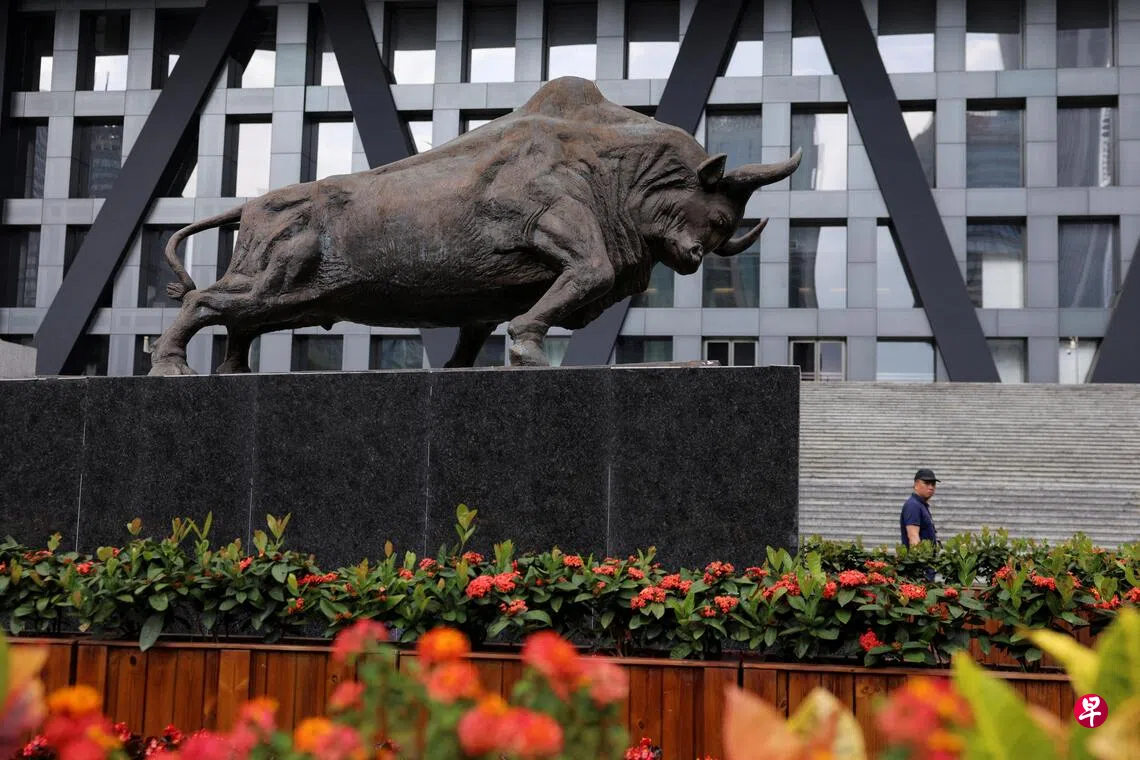
(Beijing) — Beijing has unveiled a package of measures to stabilise the stock market after Chinese shares closed sharply lower on Friday (20 November). These include allowing the country’s three main stock exchanges to lower the minimum margin requirement for share purchases financed through borrowing, potentially freeing up nearly 400 billion yuan (S$77.25 billion) in additional funds for the market.
The Shanghai, Shenzhen and Beijing stock exchanges announced on Sunday (22 November) that they would cut the minimum margin requirement for securities purchases financed through borrowing from 100% to 80%, following approval from the China Securities Regulatory Commission, according to CCTV News, Xinhua and other outlets. The new rules will take effect on 30 November.
The margin requirement determines how much investors can borrow to buy shares relative to the collateral they provide. Following the adjustment, investors with 1 million yuan in collateral can borrow from brokerages to buy up to 1.25 million yuan worth of securities, up from 1 million yuan previously. This raises the financing leverage ratio from one to 1.25 times.
According to The Paper, regulatory sources estimate that outstanding margin financing in China’s stock market currently stands at about 2.2 trillion yuan. Lowering the margin requirement could free up nearly 100 billion yuan for new margin trades. If brokerages apply the new ratio to existing margin financing contracts, a further 300 billion yuan could be released, bringing the total to nearly 400 billion yuan.
The three exchanges said margin trading activity had declined markedly recently and overall leverage was not high. A moderate reduction in the margin requirement, under statutory countercyclical adjustment arrangements, would help raise leverage modestly, expand financing capacity and improve market liquidity, supporting the market’s stable and healthy development over the long term.
This is China’s second adjustment to the margin requirement this year. In January, regulators raised it from 80% to 100% to guard against market overheating. The latest move reverses that increase, signalling that regulators are using countercyclical measures to adjust market trading activity.
Dragged down by a heavy sell-off on Wall Street, the Shanghai Composite Index and the CSI 300 both closed on Friday at their lowest levels since July last year. The smaller Shenzhen Component Index fell 3.6%, the ChiNext Composite Index dropped 3.5%, and Shanghai’s technology-focused STAR 50 Index declined 3.1%.
The Shanghai and Shenzhen stock exchanges also announced a fresh round of fee reductions on Sunday, including waivers of trading unit usage fees and reductions or waivers of data centre service fees. Existing waivers of listing fees, bond transaction handling fees and other charges will also be extended by two years to 2028 to lower costs for market participants.
The new fee reductions introduced by the Shanghai and Shenzhen exchanges are expected to save market participants 1.368 billion yuan and 1.39 billion yuan respectively. Total fee reductions at the two exchanges this year are expected to exceed 2.4 billion yuan and 2.2 billion yuan respectively.
The exchanges stressed that brokerages must strengthen risk management for margin financing and securities lending, and strictly enforce margin requirements for investors engaging in abnormal trading behaviour to guard against excessive speculation.
Another measure is a proposal to introduce a market-maker system on the ChiNext board. In an announcement on Sunday, the Shenzhen Stock Exchange proposed rules governing market-making in ChiNext shares and sought public feedback. The exchange said the move would help strengthen support for market stability, reduce share price volatility and enhance market resilience.
